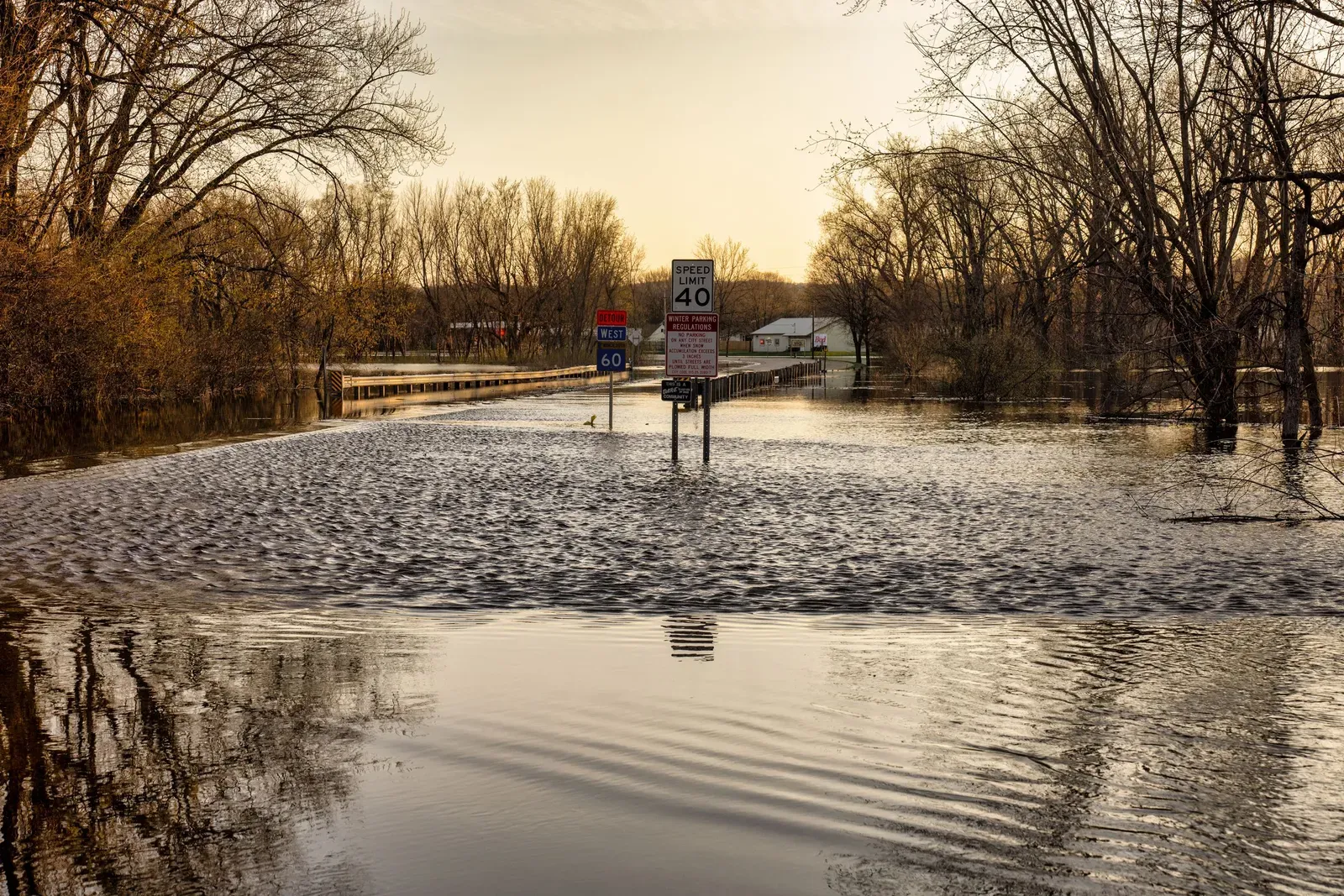
When FHWA convened two peer exchanges on pavement resilience in 2020, drawing 92 participants from federal, state and local agencies, industry and universities, the hazard they ranked first was not heat. “In both peer exchanges, the top issue identified by attendees was climate change related pavement inundation,” from tidal flooding, from coastal storms, from riverine events inland, and from a fourth mechanism that rarely reaches public discussion: rising seas acting on tidal rivers so that “the high tide acts as a ‘dam’ that can causes flooding many miles upstream.” Temperature came up, and it came up as the smaller worry.
That ordering is a corrective to how this subject is usually framed. Water is the dominant stressor on a paved road, in every form it takes.
Resilience is a defined term, and it does not mean stronger
Federal statute defines resilience for a transportation project as the ability “to anticipate, prepare for, and or adapt to changing conditions and or withstand, respond to, and or recover rapidly from disruptions,” with the ability to resist hazards or “reduce the magnitude or duration of impacts.” Recovery sits alongside resistance in the definition, with equal standing.
FHWA’s hydraulics guidance draws the practical consequence more sharply than the statute can. “Designing for resilient performance and behavior under adverse conditions does not imply designing for larger discharges (smaller AEP). Resilience implies understanding what happens when events occur that are other than the design flow.” A bigger culvert is one answer among several, and often not the cheapest. The federal review of practice adds that resilience “is not an absolute quality” and that “Optimal resilience for one asset or system may have detrimental effects on others,” which is why raising a road can worsen flooding on the far side of it.
Five stressors, five different failure mechanisms
Heat works on stiffness. A performance-graded binder is a bet on the temperature 20 millimeters below the surface, taken at a confidence level a district chose from a range, and how extreme heat damages roads follows that bet through rutting, bleeding and the concrete blow-ups that appear when a joint runs out of expansion room. It also examines why the mechanism agencies use to buy heat resistance was built for slow-moving traffic rather than for warming, and how a published grade map can be shaped in part by what binder suppliers actually stock.
Inland flooding works on probability. The federal minimum design flood in 23 CFR 650 subpart A applies to the through lanes of Interstate highways and to nothing else, and freeboard is required only “where practicable.” Designing highways for flood resilience works through what a design event promises, why a 50-year storm under a 75-year design life carries a 78 percent chance of exceedance, and a Mobile, Alabama culvert study in which one climate narrative raised peak flows by 72 to 80 percent while an equally likely narrative raised them not at all.
Sea level works on elevation, and it is the only stressor here whose direction is not in dispute. Sea-level rise and America’s coastal highways starts from the finding that the federal scenarios diverge mostly after 2050, which makes the near term the confident planning horizon, and then prices one adaptation honestly: raising an Annapolis road by a foot would cut its flood count to a handful, and by roughly 2065 to 2070 it would flood as often as it does now.
Fire works twice, and the second time is the expensive one. How wildfires threaten highway infrastructure follows Glenwood Canyon from the fire in the Interstate median through the debris flows of the following summer, including a rockfall fence program with a defensible benefit-cost case that was partly destroyed by a flow larger than it was designed to absorb, and it sets out why the published cost totals for the same event differ by an order of magnitude.
Frost works on support. Ground thaws downward, water is trapped above still-frozen soil, and a structure that was above its rated capacity in January drops below it in April. Freeze-thaw cycles reads Minnesota’s published load restriction calendar as evidence of that swing, and returns to a 1,250-patch federal experiment whose most useful result was not about patching materials at all.
What is unresolved
The gaps in this field are not rhetorical, and FHWA has named the main ones itself. Current pavement design does not account for inundation and loss of support. There is no settled method for judging when a flooded pavement can safely carry traffic again, and the one state protocol described in the federal literature found that full structural capacity can take weeks to return. And every environmental input in every mainstream design tool is drawn from historical climate data, which FHWA itself says may no longer predict the conditions those tools are being used to design for.
Underneath those sits a question about money. Resilience measures are justified by benefit-cost analyses that mostly exclude user costs, that price the events an agency’s manual can already price, and that in at least one documented case explicitly did not consider how climate change might alter the hazard. Analyses built that way will keep recommending protection against the familiar event. Whether that is prudence or a category error depends on how much of the coming damage resembles the last event, and nobody has an evidenced answer yet.