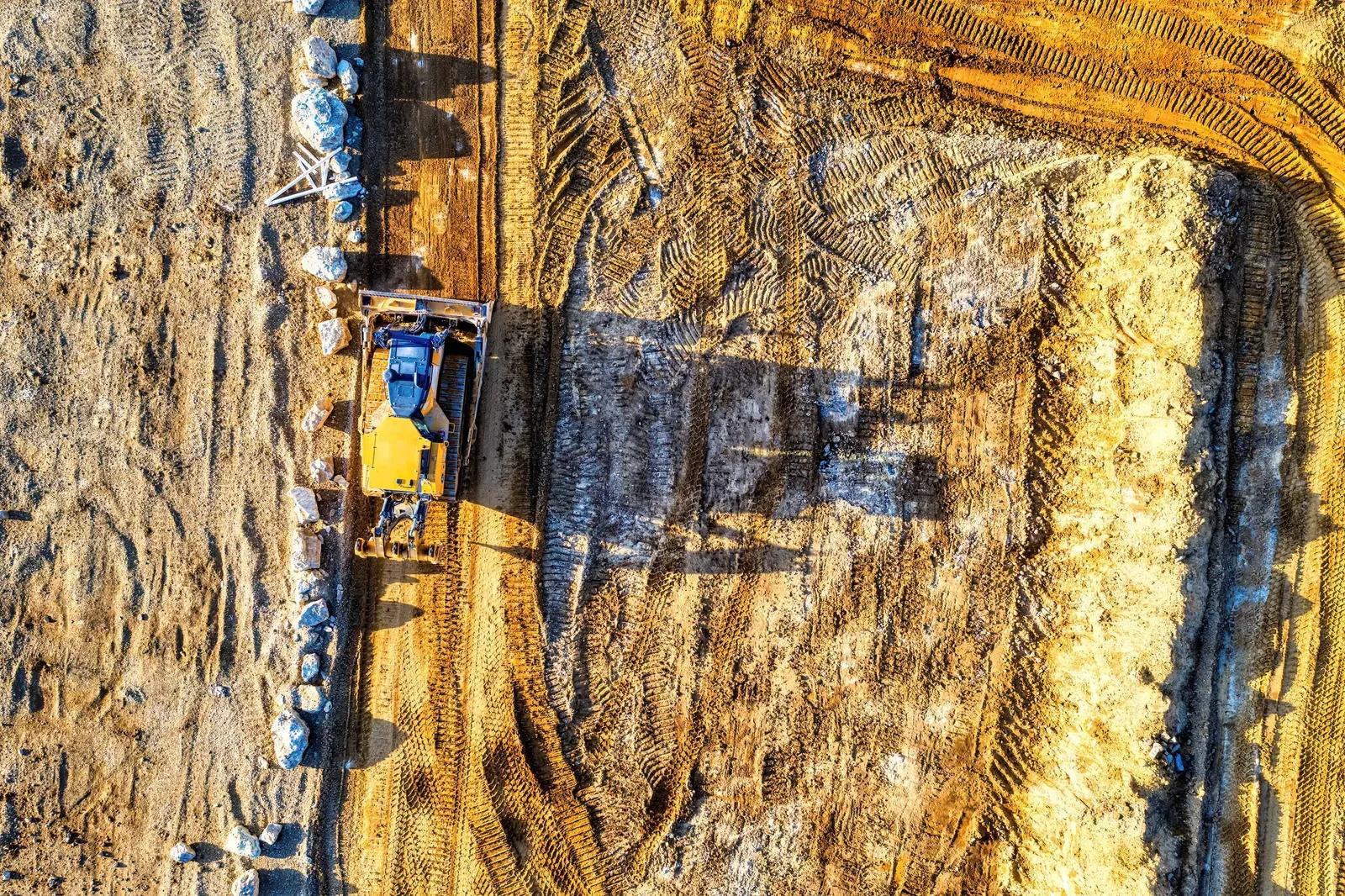
Design produces a document. Construction produces a road, and the two are never quite the same object. Between them sit a weather window, a bid schedule, a plant that can supply one gradation this month, a survey that sampled the ground every hundred feet, and a foreman deciding at four in the afternoon whether the fill goes in now or waits until Tuesday. Those decisions rarely appear in any account of a project’s sustainability, and several of them outrank everything that does.
This section works at that level. It is organized around a claim that the field’s own literature supports more readily than its promotional material does: on most American highway projects the durability of the result is set during construction, by choices that leave no visible trace in the finished surface, and the profession has better documentation of those choices than it has measurement of them.
Water, ground and the two systems that decide service life
Two subjects sit underneath everything else here. The first is water, which arrives before the road opens and never leaves. How highway drainage systems work follows it through the three separate design problems federal practice keeps apart, and the surprise is not the hydraulics. It is that the buried half of the system, the part that protects the pavement structure itself, is the half most likely to have been built wrong: federal guidance reports that roughly seven in ten edgedrains in service are not doing their job, chiefly because of how they were installed rather than how they were specified.
The second is the ground, which is the one layer a highway never gets to rebuild. Earthwork and grading takes up two facts that sit oddly together. Grading quantities are interpolated between survey sections and then multiplied by a factor that a state design manual openly calls subjective, so the volumes an entire schedule rests on carry more uncertainty than any spreadsheet shows. Meanwhile the mechanical property that matters most, the strength the embankment will still have after it gets wet, is fixed by the moisture content on the day of rolling, not by the density number the specification asks for.
Both articles arrive at the same structural point from opposite directions. The components that decide when a road comes back for reconstruction are the components nobody can inspect once the paving is done.
Who carries the unknown, and what leaves the site
Uncertainty of that kind has to be held by somebody, and the contract decides who. Design-build against design-bid-build works through the federal dataset of 291 completed projects, which is the closest thing this argument has to evidence. Its most useful findings are the ones that decline to endorse a method: cost growth did not differ significantly between the four delivery types studied, and overall, unforeseen conditions were the largest change order category. What alternative contracting reliably changes is the calendar, above all the date on which an agency knows what a project will cost.
Then there is the outbound side, which is usually treated as logistics rather than as design. How road projects manage construction waste starts from a number most readers get backwards: in the national accounting, roads and bridges generate more construction and demolition debris than buildings do. Most of it is diverted from landfill, which sounds settled until the destination is examined, because the majority of the diverted mass becomes unbound aggregate, the least demanding use available to it. Diversion and recycling are not the same measurement, and the gap between them is where the interesting specification questions live.
Last comes the clock. Why so much highway work happens at night sets out the two conditions national guidance says a job must satisfy before the night shift offers any advantage at all, and reports the crash research honestly, including the finding that the risk to an individual motorist passing an active lane closure is not much lower after dark. The gains from working at night are real. They are gains in total exposure and in public delay, paid for by the people on the shift.
What this section cannot yet answer
Four questions run underneath all five articles and none of them has a published answer.
Nobody knows which construction-stage decision moves service life the most, because agencies almost never build the control sections that would settle it. Nobody can say what a cubic yard-mile of haul costs in fuel across a program, because the quantity is calculated for estimating and never reconciled against consumption. No national dataset reports whether night work reduces total harm once worker exposure is counted, since the fatality tabulations carry no shift split. And the single variable that research called the most important factor in night construction, illumination, remains a matter of contract language rather than national standard, more than twenty years after the study that said so.
Where the evidence stops, these pages say so and name the body that would have to produce it. That is a slower kind of coverage than a list of best practices, and it is the only kind worth citing.